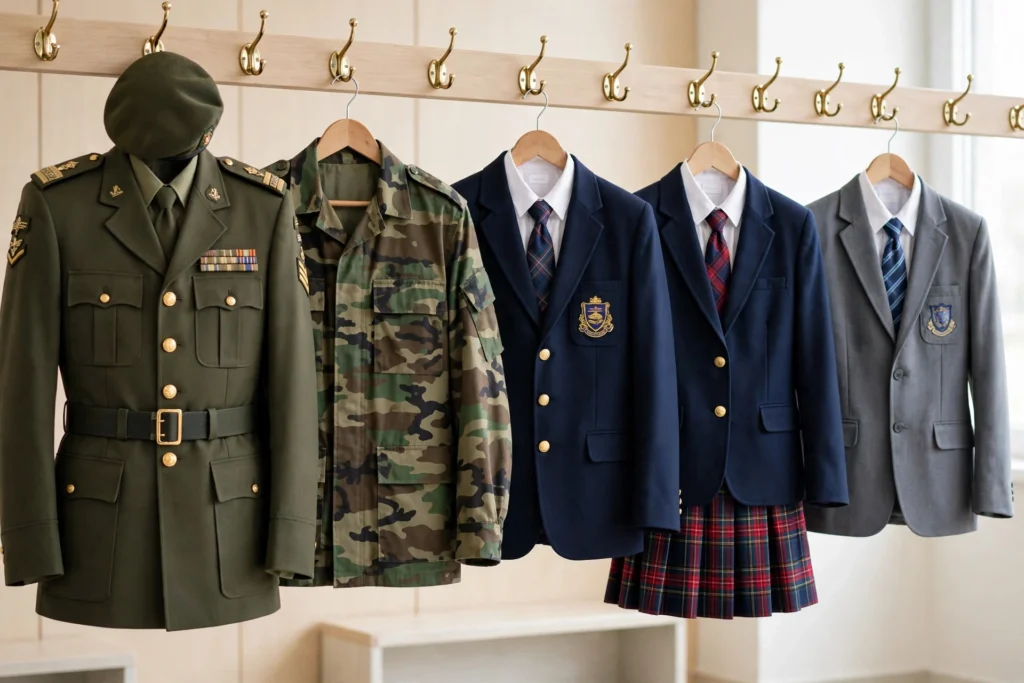
One word, two jobs. A soldier wears one. A scientist describes data with the other. They look unrelated until you see the Latin underneath. The full uniform meaning is a small masterclass in how English packs two meanings into one shape.
Quick Answer
Uniform meaning splits into two. As a noun, it’s the distinctive outfit worn by members of a group (soldiers, nurses, students). As an adjective, it means identical, consistent, or unvarying throughout.
Table of Contents
Dictionary Entry
uniform /ˈjuːnɪfɔːrm/ (YOO-ni-form), noun and adjective
- noun: An identifying outfit worn by members of a profession, organization, or rank.
- adjective: Identical or consistent; without variation (“uniform size”).
- verb: To make uniform; to clothe in a uniform.
Uniform Meaning in Simple Words
The trick is the Latin root: unus (one) + forma (form, shape). Uniform = one form. Everything wearing or described as uniform shares a single form.
The noun applies it to clothes: everyone in the group wears one form of dress. Soldiers, police, nurses, pilots, students, athletes. The outfit erases individuality and announces belonging. Cambridge defines it as “a particular set of clothes that has to be worn by the members of the same organization.” See Cambridge’s entry for uniform.
The adjective applies it to anything: one form throughout. Uniform color (no patches), uniform speed (no speeding up or slowing), uniform policy (same rules everywhere). Dictionary.com lists it first as “identical or consistent, as from example to example, place to place, or moment to moment.” Read Dictionary.com’s uniform entry.
Why Groups Wear Uniforms
The noun sense runs on psychology:
Identity. A uniform says “I belong” instantly: to an army, a hospital, a team, a school. Strangers know your role before you speak.
Equality. Same clothes flatten visible differences of wealth and status. That is the classic argument for school uniforms.
Authority. A police uniform commands compliance in a way plain clothes can’t. The outfit borrows the institution’s power.
Practicality. Scrubs, fire gear, military fatigues: designed for the job, not fashion.
Critics note the flip side: uniforms can suppress individuality and enforce conformity. Both effects are real, and that tension is part of the living uniform meaning; societies keep debating the balance.
The Adjective in Action
The adjective sense appears everywhere once you look:
- Science: uniform motion (constant velocity), uniform distribution (even spread).
- Business: uniform pricing (same price everywhere), uniform standards.
- Everyday: uniform color, uniform texture, uniform results.
Opposite: non-uniform, varying or irregular. A non-uniform policy treats cases differently; non-uniform heating leaves cold spots.
Uniform as a Verb
Less common but real: to uniform means to make uniform or to clothe in a uniform. “The company uniformed its procedures across all branches.” “The school decided to uniform all students.” Formal, a bit stiff, mostly in institutional writing.
Where the Word Came From
The uniform meaning comes from Latin uniformis (having one form), via French uniforme, entering English in the mid-1500s as an adjective. The noun sense (the clothes) arrived in the mid-1700s, when modern armies standardized dress. The clothes are named for the concept: one form for all.
Uniform Meaning in Everyday Sentences
- The soldiers wore dark blue uniforms.
- She takes pride in wearing her school uniform.
- The tiles are of uniform size and color.
- The new policy ensures uniform standards across branches.
- He was pictured in full military uniform.
Key Takeaways
- Uniform meaning: noun, group outfit (one form of dress); adjective, identical/consistent (one form throughout).
- Root: Latin unus (one) + forma (form). One form explains both senses.
- Pronounced YOO-ni-form; adjective since the 1500s, noun (clothes) since the 1700s.
- Uniforms signal identity, equality, authority; the adjective describes anything unvarying.
Final Thoughts
Two meanings, one root, zero confusion once you see it. Uniform is what happens when a good Latin idea, one form, gets applied to closets and then to everything else.
Whether it’s a nurse’s scrubs or a perfectly even coat of paint, that is the uniform meaning doing the same job it has done for five centuries: pointing at sameness and naming it.
Frequently Asked Questions
What does uniform mean in simple words?
As a noun, the matching outfit worn by a group’s members (soldiers, students). As an adjective, identical or consistent throughout. Both come from Latin “one form.”
What is the difference between the noun and adjective uniform?
The noun is the clothes (a soldier’s uniform). The adjective describes sameness (uniform color, uniform rules). Same root, different jobs.
Why do schools and armies use uniforms?
For identity, equality, authority, and practicality: instant recognition, flattened status differences, borrowed institutional power, and job-designed clothing.
What is the origin of the word uniform?
Latin uniformis (unus “one” + forma “form”), via French uniforme. Adjective since the mid-1500s; the clothing sense since the mid-1700s.
What is the opposite of uniform?
Non-uniform: varying, irregular, or inconsistent, as in non-uniform heating or a non-uniform policy.
How do you pronounce uniform?
YOO-ni-form: /ˈjuːnɪfɔːrm/, stress on the first syllable.