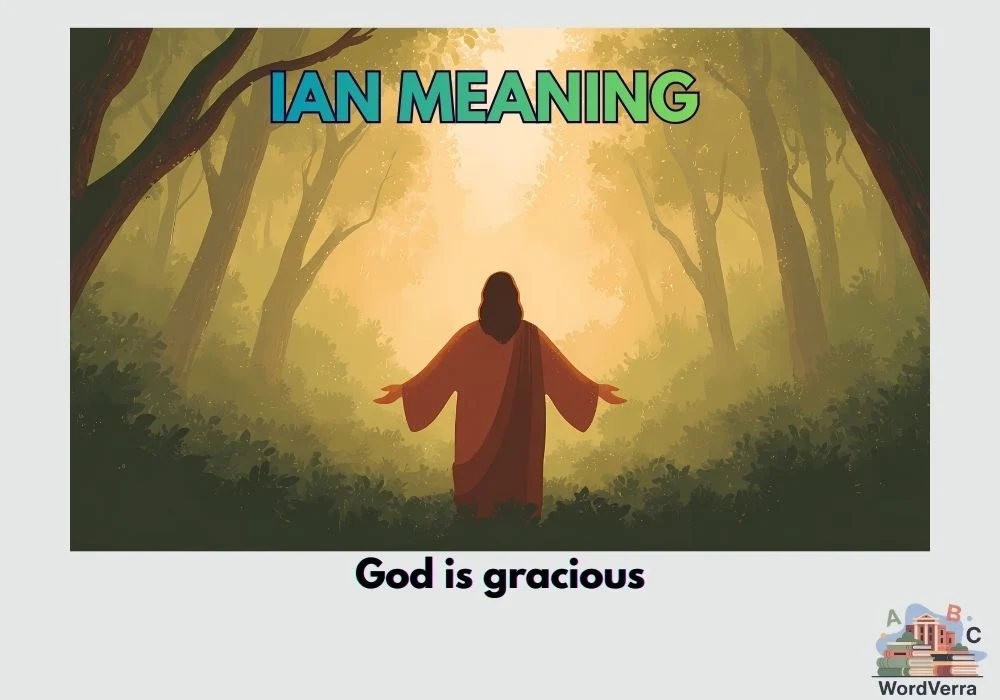
Ian Meaning: Origin, Significance, and Usage Explained 2026

Ian Meaning

The name Ian is widely recognized across the globe, often admired for its simplicity and elegance. If you’ve ever wondered about Ian meaning, origin, or cultural significance, you’ve come to the right place. Understanding this name can help you appreciate its history and popularity in modern contexts.

This article explores the meaning of Ian, its origin, variations, famous personalities with the name, and tips for using it thoughtfully in conversation or naming.


What Does Ian Mean? (Simple Definition)

In simple terms, Ian means:

“The Lord is gracious” or “God is gracious.”

It is a male given name and a Scottish variant of the name John. The meaning emphasizes kindness, blessing, and divine favor, making it a popular choice across cultures.

Example:

“Ian was chosen as a baby name because it signifies grace and blessing.”


Origin of the Name Ian

The name Ian originates from:

  • Scottish Gaelic: It is a Gaelic adaptation of the name John
  • Hebrew roots: John comes from “Yochanan,” meaning “God is gracious”
  • Usage spread across English-speaking countries during the 20th century

The name’s popularity grew due to its simplicity, easy pronunciation, and positive meaning.


Variations and Related Names

There are several variations and related names of Ian, including:

  • John (English)
  • Ivan (Slavic)
  • Sean / Seán (Irish)
  • Eoin (Irish Gaelic)

Example:

“Ian is the Scottish version, while Ivan is commonly used in Russia.”


Famous People Named Ian

Many notable individuals carry the name Ian, which contributes to its modern recognition:

  • Ian McKellen – Renowned British actor
  • Ian Fleming – Creator of James Bond
  • Ian Somerhalder – American actor known for The Vampire Diaries
  • Ian Curtis – Lead singer of the band Joy Division

These figures show the name’s wide cultural reach in arts, literature, and entertainment.


Ian Meaning in Modern Context (2026)

In 2026, the name Ian remains popular for:

  • Baby names due to its simplicity and positive meaning
  • Characters in books, movies, and video games
  • Public figures, maintaining global recognition

Example:

“Parents continue to choose Ian for its timeless elegance and meaningful origin.”


Common Misunderstandings About Ian

Mistake 1: Thinking Ian Is Short for Something

  • Ian is a standalone name, not a nickname for John, although related.

Mistake 2: Assuming Cultural Exclusivity

  • While Scottish in origin, Ian is used worldwide, including in the US, Canada, Australia, and Europe.

Mistake 3: Ignoring Pronunciation Variations

  • Ian is usually pronounced /ˈiːən/, but slight variations may exist depending on accents.

How to Use Ian in Naming or Conversation

  • Naming a child: Emphasize the positive meaning “God is gracious”
  • Referring to someone: Use respectfully, noting that it is a common male first name
  • Cultural references: Acknowledge its Scottish and global variants

Example:

“Ian is a perfect name for parents seeking a traditional yet modern choice.”


Ian Meaning in Simple Words (Quick Reminder)

Ian is a male name meaning “God is gracious,” originating from Scottish Gaelic and related to John.


Conclusion

To summarize:

  • Ian is a timeless and meaningful male name
  • It has Scottish origins with Hebrew roots
  • Related names include John, Ivan, Sean, and Eoin
  • Its popularity continues in modern times due to simplicity, elegance, and positive connotation

Succinct Meaning: Definition, Usage, and Examples 2026

Succinct Meaning

The word succinct is widely used in writing, communication, and professional contexts. Understanding succinct meaning helps you communicate clearly and concisely, a valuable skill in 2026 where time and attention are limited.

This article explores the meaning of succinct, its origin, examples of usage, common mistakes, and tips on using it effectively in modern language.


What Does Succinct Mean? (Simple Definition)

In simple terms, succinct means:

Expressed clearly and briefly, without unnecessary words.

It describes communication, writing, or speech that is concise, to the point, and easily understandable.

Example:

“Her presentation was succinct, covering all the key points in just ten minutes.”


Origin of the Word Succinct

The word succinct comes from the Latin “succinctus”, which means:

  • Girded up or tucked in, symbolizing something neatly contained
  • Derived from “sub” (under) + “cingere” (to gird or encircle)

In English, it has been used since the 15th century to describe concise writing or speech.


Succinct Meaning in Everyday Life

In daily contexts, succinct applies to:

  • Emails and text messages
  • Verbal instructions
  • Academic or business writing
  • Public speaking

Examples:

  • “Please give a succinct summary of the report.”
  • “Keep your answers succinct during the interview.”

The goal is to communicate effectively without extra fluff.


Synonyms of Succinct

Words with similar meaning include:

  • Concise
  • Brief
  • Clear
  • Terse
  • To the point

Example:

“Her succinct explanation helped everyone understand the topic quickly.”


Common Misunderstandings About Succinct

Mistake 1: Confusing Succinct With Rude or Abrupt

  • Succinct communication is concise, not impolite.
  • Example: “Succinct emails are professional, not cold.”

Mistake 2: Overusing Succinct in Casual Speech

  • It is best suited for formal, professional, or academic contexts, though casual use is acceptable when clarity matters.

Mistake 3: Believing Succinct Means Short Only

  • Succinct emphasizes clarity and relevance, not just word count. A short message can still be verbose if unclear.

How to Use Succinct in Sentences

  • Describing writing:

“The report was succinct and easy to read.”

  • Describing speech:

“She gave a succinct answer to the interviewer’s question.”

  • Offering advice:

“Keep your presentation succinct to maintain the audience’s attention.”


Succinct Meaning in Modern Context (2026)

In 2026, succinct is increasingly important in:

  • Professional emails and reports
  • Social media posts and captions
  • Online courses and webinars
  • News articles and summaries

Example:

“In today’s fast-paced world, succinct communication is valued more than ever.”

It highlights efficiency, clarity, and respect for the reader’s time.


Succinct Meaning in Simple Words (Quick Reminder)

Succinct means clear, brief, and to the point, without unnecessary words.


Conclusion

To summarize:

  • Succinct describes communication that is concise and clear
  • Synonyms include concise, brief, and to the point
  • Using succinct communication enhances professionalism, clarity, and efficiency
  • Understanding succinct meaning helps you communicate better in writing, speech, and digital content

TMP Meaning in Text: Definition, Usage, and Examples 2026

TMP Meaning in Text

If you’ve come across TMP in texts, chats, or social media and wondered what it means, you’re not alone. Abbreviations like TMP are increasingly common in modern digital communication, and understanding them is key to keeping up with texting culture.

This article explains the TMP meaning in text, its origin, usage examples, related slang, and common misunderstandings, fully updated for 2026.


What Does TMP Mean in Text?

In texting and online messaging, TMP commonly stands for:

“Too Much Pressure”

It is used to express feelings of stress, overwhelm, or being burdened by expectations or responsibilities.

Example:

“I can’t handle all these assignments, TMP right now.”

Here, the sender conveys that the workload is overwhelming.


Other Possible Meanings of TMP in Text

While “Too Much Pressure” is the most common interpretation in casual texting, TMP can also mean:

  • Temporary – often used in notes or informal online writing
  • The Most Powerful – sometimes used humorously in games or social media
  • Team Member Project – in work-related group chats

Context is crucial when interpreting TMP, as the meaning changes depending on the conversation.


Origin of TMP in Texting

The abbreviation TMP comes from internet and mobiletexting culture, where users aim to save time by using initials for common phrases or concepts.

  • “Too Much Pressure” likely emerged in online forums and social media platforms
  • Temporary uses often come from workplace or educational settings
  • Today, TMP is part of the broader trend of using acronyms to communicate quickly in digital spaces

How to Use TMP in Texts and Chats

  • Expressing stress or overwhelm:

“This project deadline is TMP, I need a break.”

  • Shortening phrases for quick communication:

“TMP assignment due tomorrow, anyone else ready?”

  • Casual social media use:

“That game was TMP, couldn’t handle the last level!”

Tips:

  • Make sure the recipient knows the context
  • Use TMP in informal conversations, not formal emails or documents

Common Misunderstandings About TMP

Mistake 1: Assuming One Meaning

  • TMP has multiple interpretations; always consider context.

Mistake 2: Using TMP in Formal Writing

  • Abbreviations like TMP are suitable for texting, chat, or social media, not professional or academic writing.

Mistake 3: Confusing TMP With Similar Acronyms

  • TMP is different from TMI (“Too Much Information”) or TBF (“To Be Fair”).

Example:

“TMP” = Too Much Pressure
“TMI” = Too Much Information


Related Slangs or Abbreviations

  • TMI – Too Much Information
  • SMH – Shaking My Head
  • IDK – I Don’t Know
  • BRB – Be Right Back

Knowing related slang helps you understand digital communication better.


TMP Meaning in Modern Context (2026)

In 2026, TMP is commonly used in:

  • Texting among friends
  • Social media captions and replies
  • Online gaming chats
  • Group messaging apps

Example:

“TMP with all these notifications, my phone won’t stop buzzing!”

It reflects the digital generation’s tendency to communicate emotions and reactions quickly.


TMP Meaning in Simple Words (Quick Reminder)

TMP usually means “Too Much Pressure” in texts, expressing stress or overwhelm, but can also mean temporary or other context-dependent phrases.


Conclusion

To summarize:

  • TMP meaning in text usually stands for Too Much Pressure, expressing overwhelm
  • It can also mean Temporary, The Most Powerful, or Team Member Project depending on context
  • TMP is part of digital slang and widely used in texting, social media, and online chats
  • Understanding TMP helps you interpret messages accurately and participate effectively in online conversations

Prune Meaning: Definition, Uses, and Examples Explained 2026

Prune Meaning

The word prune can have multiple meanings depending on the context—ranging from food to gardening, and even figurative language. Understanding prune meaning helps you interpret texts accurately, communicate clearly, and use the term appropriately in conversation or writing.

This article explores the meaning of prune, its origin, examples, common misunderstandings, and modern usage, updated for 2026.


What Does Prune Mean? (Simple Definition)

Prune has two main definitions:

  1. As a noun (food): A dried plum, often eaten as a snack or used in cooking.
    Example: “Prunes are rich in fiber and are great for digestion.”
  2. As a verb (gardening or figuratively): To trim or cut away unwanted parts of a plant or, figuratively, to remove unnecessary elements from something.
    Example (gardening): “I need to prune the rose bushes before winter.”
    Example (figurative): “The editor pruned the article to make it clearer.”

Origin of the Word Prune

The word prune comes from Latin “prunum”, meaning plum.

  • It entered English through Old French in the 14th century
  • Originally referred only to the fruit, but the verb sense evolved from the idea of cutting or thinning (like trimming fruit trees)

Prune Meaning in Everyday Life

In daily life, prune is used both literally and figuratively:

  • Literal (food):
    “She enjoys eating prunes as a healthy snack.”
  • Gardening (verb):
    “The gardener pruned the hedges to keep them neat.”
  • Figurative (editing or improving):
    “We pruned the team’s workflow to make it more efficient.”

Prune in Health and Nutrition

Prunes are often associated with:

  • Digestive health: High in fiber and natural laxatives
  • Vitamins and minerals: Contain potassium, vitamin K, and antioxidants
  • Dietary benefits: Used in snacks, baked goods, or smoothies

Example:

“Adding prunes to your diet can help maintain healthy digestion and energy levels.”


Common Misunderstandings About Prune

Mistake 1: Confusing Prune With Plum

  • A prune is a dried plum, not a fresh fruit.

Mistake 2: Thinking Prune Only Refers to Food

  • As a verb, prune can mean trimming plants or removing unnecessary parts in a figurative sense.

Mistake 3: Mispronunciation

  • Correct pronunciation: /pruːn/

Synonyms of Prune

Depending on context, synonyms include:

  • For food: dried plum
  • For gardening: trim, cut back, clip
  • For figurative use: streamline, reduce, remove

Example:

“The company pruned unnecessary expenses to improve efficiency.”


How to Use Prune Correctly in Sentences

  • Literal (food):

“Prunes are a nutritious snack.”

  • Gardening:

“You should prune the trees in early spring.”

  • Figurative:

“The writer pruned the manuscript to make it concise.”


Prune Meaning in Modern Context (2026)

In 2026, prune is used in:

  • Health and nutrition articles
  • Gardening and horticulture content
  • Figurative business or productivity advice
  • Cooking and recipe blogs

Example:

“Prune your digital files regularly to keep your computer organized.”

The term remains versatile, making it relevant in multiple fields.


Prune Meaning in Simple Words (Quick Reminder)

Prune can mean a dried plum, to trim plants, or to remove unnecessary elements figuratively.


Conclusion

To summarize:

  • Prune as a noun refers to a dried plum, and as a verb means to trim or remove
  • It is used in gardening, cooking, health, and figurative language
  • Synonyms include trim, clip, dried plum, and streamline
  • Understanding prune meaning helps you use the word accurately in conversation, writing, and practical contexts

No Taxation Without Representation Meaning: History 2026

No Taxation Without Representation Meaning

The phrase “no taxation without representation” is one of the most famous slogans in American history. If you’ve ever wondered about the meaning of no taxation without representation, its origins, and why it still matters today, this article breaks it down for you in clear and engaging terms.

Updated for 2026, this guide explores the historical context, practical meaning, examples, and modern implications of this iconic phrase.


What Does No Taxation Without Representation Mean?

In simple terms, no taxation without representation means:

The government should not impose taxes on citizens unless those citizens have elected representatives in the decision-making process.

The phrase emphasizes fairness and consent in governance. If people do not have a voice in how taxes are levied or spent, they are being unfairly burdened.

Example:

“The colonists protested because they faced taxes without being allowed to vote in Parliament—no taxation without representation.”


Origin of the Phrase

The slogan “no taxation without representation” emerged in the 18th century during the buildup to the American Revolution. Key points include:

  • British Parliament imposed taxes on American colonies, such as the Stamp Act (1765) and Tea Act (1773)
  • Colonists had no representatives in Parliament to voice their concerns
  • Leaders like James Otis and Patrick Henry popularized the phrase as a rallying cry for independence

The slogan became a symbol of political rights and democratic principles.


Historical Context

The idea reflects the belief that:

  • Government authority comes from the consent of the governed
  • Citizens should have participation in decision-making affecting their lives and finances
  • Taxation without representation is unjust and oppressive

Example:

“During protests in Boston, colonists shouted slogans like ‘no taxation without representation’ while resisting British policies.”

This phrase played a crucial role in motivating the American Revolution (1775–1783) and shaping the founding principles of the United States.


Modern Meaning and Relevance

Today, the phrase is used beyond its historical context to represent fair representation in governance:

  • Voting rights advocacy
  • Local, state, and national elections
  • Civic engagement campaigns

Example:

“Citizens argue that certain policies violate the principle of no taxation without representation if they have no voice in legislative decisions.”

The slogan serves as a reminder of democratic accountability and civic rights.


Common Misunderstandings About No Taxation Without Representation

Mistake 1: Thinking It Only Applies to Taxes

  • While it originated with taxation, it broadly refers to any policies that affect people without their input.

Mistake 2: Believing It’s Only American

  • Other countries have used similar principles in governance debates, emphasizing representation in democracy.

Mistake 3: Confusing Symbolism With Legal Application

  • The phrase is both a historical slogan and a political principle, not a specific law.

How to Apply This Principle Today

Understanding no taxation without representation helps in:

  • Promoting voter registration and participation
  • Advocating for inclusive political processes
  • Educating citizens about fair governance

Example:

“Communities use the principle to challenge unfair local taxes imposed without proper public input.”


Synonyms and Related Concepts

  • Fair taxation
  • Democratic participation
  • Civic representation
  • Political accountability
  • Government transparency

Example:

“The concept of civic representation is central to no taxation without representation.”


No Taxation Without Representation Meaning in Simple Words (Quick Reminder)

It means people should not be taxed by a government unless they have a voice in the decisions through elected representatives.


Conclusion

To summarize:

  • No taxation without representation originated in 18th-century America as a protest against unfair taxes
  • The slogan represents fairness, consent, and democratic participation
  • Its modern relevance extends to voting rights, civic engagement, and governance accountability

Understanding this principle helps citizens advocate for representation, fairness, and democratic rights.

Grey Divorce Meaning: Definition, Causes, and Insights 2026

Grey Divorce Meaning

The term grey divorce has become increasingly common in recent years, as more couples over 50 end long-term marriages. Understanding grey divorce meaning is important for recognizing the unique challenges and dynamics of later-life separations.

This article explores the meaning of grey divorce, its causes, emotional and financial implications, and tips for navigating it, fully updated for 2026.


What Does Grey Divorce Mean?

In simple terms, grey divorce refers to:

The divorce of couples typically aged 50 or older after long-term marriages.

It differs from younger divorces because it involves:

  • Established careers
  • Shared financial assets
  • Adult children or grown families
  • Retirement planning considerations

Example:

“After 30 years of marriage, they faced a grey divorce, adjusting to new financial and emotional realities.”


Origin of the Term Grey Divorce

The term grey divorce is relatively recent, coined by researchers and media outlets to describe the trend of later-life divorces. The word “grey” reflects:

  • Older age groups (often graying hair)
  • Life stages when couples are preparing for retirement

It is now widely used in sociology, psychology, and financial planning discussions.


Causes of Grey Divorce

Grey divorces often happen due to unique circumstances, including:

  • Empty nest syndrome: When children leave home, couples reassess their relationship
  • Different retirement goals: Conflicting visions for retirement lifestyle
  • Midlife crises: Desire for new experiences or personal growth
  • Long-standing marital issues: Accumulated unresolved conflicts

Example:

“They grew apart after the children moved out, which eventually led to a grey divorce.”


Financial Implications of Grey Divorce

Divorcing later in life can have significant financial consequences:

  • Division of retirement funds and pensions
  • Impact on Social Security benefits
  • Splitting long-term assets such as real estate
  • Planning for independent living on a smaller budget

Example:

“She had to rethink her retirement plan after her grey divorce, including splitting the family home.”

Financial planning and professional advice are crucial during a grey divorce to ensure stability and security.


Emotional and Social Aspects

Grey divorces also affect emotional well-being:

  • Loneliness or social isolation
  • Adjusting to single life after decades of marriage
  • Rebuilding social networks or dating later in life

Example:

“He joined a community group to cope with the loneliness following his grey divorce.”

Understanding these aspects helps individuals prepare emotionally and socially for the transition.


Common Misunderstandings About Grey Divorce

Mistake 1: Thinking It Only Happens Due to Infidelity

  • While infidelity can be a factor, most grey divorces stem from long-term incompatibility or life-stage changes.

Mistake 2: Assuming It’s Uncommon

  • Grey divorces are on the rise globally, reflecting changing societal norms and life expectancy.

Mistake 3: Ignoring Legal and Financial Complexities

  • Later-life divorces often involve more complex financial arrangements than younger divorces.

Tips for Navigating Grey Divorce

  1. Seek professional advice: Lawyers, financial planners, and therapists can help
  2. Plan for retirement: Consider independent financial security
  3. Take care of your emotional health: Join support groups or therapy
  4. Communicate respectfully: Especially if adult children are involved

Example:

“By consulting a financial planner, she successfully managed the division of assets during her grey divorce.”


Grey Divorce Meaning in Simple Words (Quick Reminder)

A grey divorce is when people over 50 end a long-term marriage, often with unique financial and emotional considerations.


Conclusion

To summarize:

  • Grey divorce refers to divorces of older couples, usually 50+
  • Common causes include empty nests, retirement planning differences, and long-term incompatibility
  • Financial planning and emotional support are key for managing the transition
  • Understanding grey divorce meaning helps families, professionals, and individuals navigate this life stage confidently

KSI Meaning: Background & Online Presence Explained 2026

Ksi Meaning

If you’ve spent any time on YouTube, social media, or gaming communities, you’ve likely heard the name KSI. But what does KSI mean, and why is he so well-known? Understanding KSI meaning helps you navigate modern internet culture, especially in the worlds of YouTube, music, and gaming.

This article explains the meaning of KSI, his origin, rise to fame, and how the term is used today, fully updated for 2026.


What Does KSI Mean?

KSI stands for:

Knowledge, Strength, Integrity

It is the online pseudonym of Olajide Olayinka Williams Olatunji, a British YouTuber, rapper, boxer, and internet personality. The acronym reflects values that KSI wanted to represent when he started his online career.

Example:

“KSI has over 25 million subscribers on YouTube, showing the impact of his content and persona.”


Origin of KSI

  • KSI adopted his name in 2009 when he began posting content on YouTube.
  • Initially, he gained fame through gaming videos, particularly FIFA gameplay.
  • Over time, he expanded into music, boxing, and comedy content, making the KSI brand globally recognized.

The acronym itself—Knowledge, Strength, Integrity—was meant to embody personal and online values, giving fans something to connect with beyond entertainment.


KSI Meaning in Online and Social Media Culture

KSI is more than just a name; it represents a cultural phenomenon in digital spaces:

  • YouTube Content Creator: Known for gaming, reaction videos, and comedy
  • Music Career: Released rap albums and singles charting internationally
  • Boxing Career: Fought high-profile matches that attracted millions of viewers
  • Social Media Presence: Active on Instagram, Twitter, and TikTok

Example:

“Fans follow KSI for his gaming streams, music releases, and boxing updates.”


KSI Meaning in Modern Context (2026)

In 2026, KSI continues to be relevant in multiple areas:

  • Online entertainment and digital media
  • Music charts and collaborations
  • Celebrity boxing matches and esports events
  • Memes, fan communities, and social media references

He represents a multifaceted online brand, combining gaming, music, sports, and personal charisma.


Common Misunderstandings About KSI

Mistake 1: Thinking KSI is Just a Gamer

  • While he started with gaming, KSI is now also a musician, boxer, and entrepreneur.

Mistake 2: Assuming KSI is an Acronym for Random Words

  • The acronym specifically stands for Knowledge, Strength, Integrity, reflecting personal values.

Mistake 3: Confusing KSI with Other YouTubers

  • KSI is unique for his combination of entertainment, music, and sports, unlike many other YouTubers who stick to one niche.

How to Use KSI in Conversation or Online

  • Referring to the person:

“KSI just dropped a new music video.”

  • Discussing his achievements:

“KSI’s boxing match broke online viewership records.”

  • Cultural references:

“That meme is classic KSI energy.”

In all contexts, KSI is both a person and a brand, so usage depends on whether you’re talking about him personally or his content.


KSI Meaning in Simple Words (Quick Reminder)

KSI refers to a British YouTuber, rapper, and boxer, whose name stands for Knowledge, Strength, Integrity.


Conclusion

To summarize:

  • KSI is a major internet personality and entertainer
  • The acronym stands for Knowledge, Strength, Integrity
  • He has expanded from gaming into music, boxing, and social media
  • Understanding KSI meaning helps you engage with modern internet and pop culture references

Eyes Emoji Meaning: Definition, Usage, and Popular Context 2026

Eye Emoji meaning

The eyes emoji 👀 is one of the most widely used emojis in digital communication, appearing in texts, social media posts, and memes. Understanding the eyes emoji meaning is essential for interpreting tone, context, and subtle cues in modern online conversations.

This article explores the meaning of the eyes emoji, how it’s used in different contexts, examples, and common misunderstandings, fully updated for 2026.


What Does the Eyes Emoji Mean? (Simple Definition)

The eyes emoji 👀 typically represents:

Looking, observing, or drawing attention to something.

Its meaning can vary based on context, but common interpretations include:

  • Curiosity or interest
  • Suspicion or disbelief
  • Excitement or surprise
  • Flirtation or suggestiveness

Example:

“She just posted a huge announcement 👀”
Here, the emoji emphasizes curiosity or intrigue about the announcement.


Origin of the Eyes Emoji

The eyes emoji was first introduced as part of Unicode 6.0 in 2010. It was designed to represent eyes in a simple, cartoonish style, allowing people to convey looking or watching digitally.

  • Popularized on social media platforms like Twitter, Instagram, and TikTok
  • Became part of meme culture to highlight reactions, gossip, or shocking content

Eyes Emoji Meaning in Texting and Social Media

Depending on the context, the eyes emoji can have multiple interpretations:

  1. Curiosity or attention
    • Example: “I heard something interesting 👀”
  2. Suspicion or side-eye
    • Example: “You said you were busy… 👀”
  3. Flirtation or suggestive tone
    • Example: “Guess who I saw tonight 👀”
  4. Excitement or hype
    • Example: “New season drops tomorrow 👀”

The tone is usually informal and depends heavily on the accompanying text.


Eyes Emoji Meaning in Meme Culture

On platforms like Twitter and TikTok, the eyes emoji is used to:

  • Highlight drama or gossip
  • React to shocking or unexpected posts
  • Emphasize “looking” at something attention-worthy

Example:

“When your friend tells a secret you weren’t supposed to hear 👀”

In this context, the emoji conveys watching closely and reacting silently.


Common Misunderstandings About the Eyes Emoji

Mistake 1: Thinking It Always Means Flirtation

  • While sometimes suggestive, it can also mean curiosity, attention, or suspicion.

Mistake 2: Overusing It

  • Using 👀 excessively can confuse the message or make it seem sarcastic.

Mistake 3: Ignoring Context

  • Always consider the accompanying text and platform culture before interpreting the emoji.

How to Use the Eyes Emoji Correctly

  • To express curiosity:

“New project coming soon 👀”

  • To hint at gossip or secrets:

“I know something you don’t 👀”

  • To react to surprising news:

“You got the promotion? 👀”

Pro tip: Pairing the eyes emoji with other emojis can clarify tone, such as 😏 for flirtation or 🤯 for shock.


Eyes Emoji Meaning in Simple Words (Quick Reminder)

The eyes emoji 👀 represents looking, observing, curiosity, attention, or surprise, depending on the context.


Conclusion

To summarize:

  • Eyes emoji 👀 is versatile, conveying curiosity, suspicion, attention, or flirtation
  • Its meaning depends heavily on context, accompanying text, and platform culture
  • Understanding the eyes emoji meaning helps in reading online messages accurately and communicating effectively

Waist Beads Meaning: History, Significance, and Modern Use 2026

Waist Beads Meaning

Waist beads are more than just decorative accessories—they carry cultural, spiritual, and personal significance across generations. Understanding waist beads meaning helps you appreciate their symbolism, uses, and relevance in modern fashion and wellness.

This article explores the meaning of waist beads, their history, cultural significance, modern applications, and tips for wearing them in 2026.


What Are Waist Beads?

Waist beads are small strands of beads worn around the waist or hips, traditionally made of glass, metal, or crystal beads strung on thread or wire. They can be worn for aesthetics, cultural reasons, body awareness, or spiritual purposes.

Example:

“She wore colorful waist beads under her clothing as a personal accessory and a symbol of femininity.”


Waist Beads Meaning in Different Cultures

Waist beads hold rich cultural significance, especially in African traditions:

  • West Africa:
    • Worn by women to symbolize femininity, sensuality, and rites of passage
    • Often given to girls during puberty as part of coming-of-age ceremonies
  • Spiritual and Protective Uses:
    • Believed to attract positive energy or protect the wearer
    • Sometimes infused with herbs or charms for personal empowerment
  • Symbol of Wealth and Status:
    • Beads can indicate social standing or family heritage, with more elaborate beads reflecting higher status

Modern Uses of Waist Beads (2026)

Today, waist beads are embraced globally for multiple purposes:

  1. Fashion and Aesthetic Appeal
    • Worn under or over clothing to complement style
    • Used to accentuate curves and body shape
  2. Body Awareness
    • Helps track weight fluctuations naturally
    • Encourages self-love and body confidence
  3. Spiritual and Healing Purposes
    • Crystals or colors may represent energy, protection, or intention
    • Used in rituals or meditation for personal growth
  4. Expression of Identity
    • Represents cultural pride and connection to ancestry
    • A form of self-expression or empowerment

Example:

“She chose waist beads with rose quartz to symbolize love and healing energy.”


Common Misunderstandings About Waist Beads

Mistake 1: Thinking Waist Beads Are Only for Seduction

  • While they can enhance sensuality, waist beads also symbolize culture, spirituality, and personal growth.

Mistake 2: Believing They Are Only for Adults

  • In some cultures, girls receive waist beads during puberty as a rite of passage.

Mistake 3: Wearing Waist Beads Incorrectly

  • Waist beads should fit comfortably; tight or loose beads can defeat their purpose.

How to Wear Waist Beads Correctly

  • Placement: Around the natural waist, hips, or lower belly depending on preference
  • Fit: Comfortable enough to move freely but snug enough to stay in place
  • Layering: Can be layered with multiple strands for aesthetic or symbolic purposes
  • Materials: Choose beads according to intention (glass for style, crystal for energy, metal for durability)

Waist Beads Meaning in Simple Words (Quick Reminder)

Waist beads are decorative or symbolic strands worn around the waist to celebrate femininity, culture, spirituality, and personal empowerment.


Conclusion

To summarize:

  • Waist beads meaning spans culture, fashion, spirituality, and personal growth
  • Traditionally worn in African societies, they symbolize femininity, rites of passage, and empowerment
  • In 2026, waist beads are globally recognized as a stylish and meaningful accessory
  • Wearing waist beads is a blend of aesthetic expression, body awareness, and cultural pride

Suddle / “Suddle” Meaning Explained: Definitions, Origins 2026

Suddle / “Suddle” Meaning Explained

If you’re searching for the meaning of “suddle”, you’ve likely encountered a word that’s very uncommon or possibly a misspelling/misheard form of another term. Unlike everyday English words, suddle isn’t widely recognized in standard dictionaries, but it does have historical and dialectal roots as well as online slang interpretations. This article breaks down what suddle meaning can be depending on context and how to interpret it correctly in writing and speech.


Does “Suddle” Have a Standard Definition? (Dictionary Insight)

Yes—in rare or archaic English usage, a form of the word suddle appears in very old references:

  • As an archaic/dialect term meaning to soil, stain, or make dirty, especially clothes or fabric. Merriam-Webster+1
  • It appears in some regional or Scots dictionaries with this meaning of soiling or smudging. dsl.ac.uk

Example (archaic usage):

“His coat was suddled after walking through the muddy field.”

This historical meaning is rare and not commonly used in modern English, but it is documented. Merriam-Webster


Is “Suddle” a Real Modern Word?

In modern English, suddle is not a commonly accepted word in standard usage. You might see it:

  • As a misspelling of subtle (common in casual typing or informal online texts) englishforward.com
  • In non‑standard slang or community‑generated definitions such as on some fan‑made sites, where it’s described creatively (e.g., a joking slang meaning like “someone extremely boring”) fastslang.com
  • As part of music titles or artist names, where it functions as a proper name without meaning tied to standard vocabulary. Apple Music – Web Player

However, these modern uses are not part of widely accepted English vocabulary.


Common Confusion: Suddle vs. Subtle

One of the biggest reasons people look up suddle is because they intended to use the word subtle—a common English adjective meaning not obvious or delicate in effect. This often happens because:

  • “suddle” is a typo of “subtle”
  • People pronounce subtle without the “b,” which can lead to spelling guesswork online englishforward.com

👉 If your context is something like “a suddle difference,” it almost certainly should be subtle difference.


Dialect and Historical Use

In older texts and regional dialects (especially Scottish English), similar words (e.g., suddle or suddle) are used to describe:

  • Stains or smudges on clothing
  • The act of soiling fabric or surfaces
    These forms come from older language influences and are rare in contemporary writing. dsl.ac.uk

Example (dialect usage):

“The child’s garment was suddled from playing outside.”

This version keeps the root meaning tied to making something dirty or marked.


Possible Slang Interpretations Online

Some non‑dictionary slang sources (community sites, casual slang lists) have described “suddle” loosely—but with no authoritative backing—as:

  • A derogatory term for someone boring or uninteresting fastslang.com

→ This slang interpretation is not recognized in standard English and should be used with caution, as the meaning varies by user and platform.


How to Interpret “Suddle” in Context

To understand usage:

  • If it appears in old or dialect English, it likely refers to soiling or staining.
  • If it’s in modern casual writing or internet slang, it may be a misspelling of subtle or a playful invented term.
  • If it’s in titles or names (songs, usernames), it may simply be a brand or creative label with no lexical meaning.

Key tip: Check surrounding text to see if it’s used as a description (likely misspelling) or historical usage.


Is “Suddle” Common in 2026 English?

In 2026, suddle is still not common in standard everyday English. People learning or using English today will almost always encounter:

  • Subtle (correct formal word)
  • Rare dialect/historical forms only in literature or specialized dictionaries

Using “suddle” in formal writing is generally not recommended unless you are quoting historical text or discussing a specific dialect form.


Summary: Suddle Meaning in Easy Words

Suddle” is an uncommon or archaic word meaning to soil or stain, but in most modern contexts it appears as a misspelling of “subtle” or as a slang/creative term without a consistent meaning.