The word upon is a common English preposition that appears in literature, formal writing, and everyday communication. Understanding upon meaning is essential for reading comprehension, writing accurately, and expressing ideas clearly.
This article explores upon meaning, its usage in different contexts, examples, and tips for avoiding common mistakes, fully updated for 2026.
What Does Upon Mean? (Simple Definition)

In simple terms, upon is a preposition that generally means:
“On” or “immediately after” or “as a result of.”
It is often used to indicate:
- Physical position or contact
- Time or sequence
- Cause or reliance
Example:
“Once upon a time, there was a small village.”
Here, upon refers to a point in time, setting the stage for the story.
Upon Meaning in Time and Sequence
Upon is often used to indicate something happening immediately after another event.
Examples:
- “Upon receiving the letter, she called her friend.”
- “The manager acted promptly upon hearing the news.”
It emphasizes immediacy or consequence in an action.
Upon Meaning in Physical Position
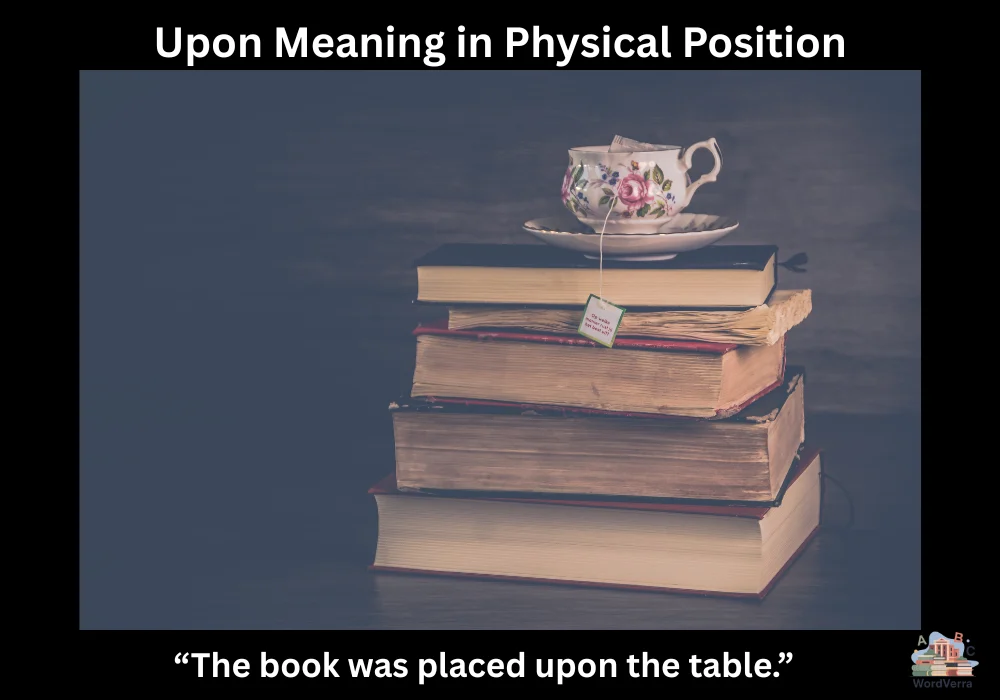
In a literal sense, upon can mean on top of or resting on something.
Examples:
- “The book was placed upon the table.”
- “A light mist settled upon the fields in the morning.”
This usage is more formal than simply saying on.
Upon Meaning in English
Upon is a preposition that means:
👉 on, immediately after, or at the time of, depending on the context.
Examples:
- The cat jumped upon the wall. = The cat jumped on the wall.
- Upon hearing the news, she smiled. = As soon as she heard the news, she smiled.
- His decision was based upon the evidence. = His decision was based on the evidence.
Synonyms:
- On
- After
- Following
- At
Upon Meaning in Cause or Condition
Upon can indicate that something depends on or is influenced by something else.
Examples:
- “Success depends upon dedication and effort.”
- “The outcome rests upon careful planning.”
It highlights reliance or conditionality.
Upon Meaning in Literature and Formal Writing
In literature, speeches, and formal writing, upon adds a poetic or authoritative tone.
Examples:
- “Once upon a time…” (classic story opening)
- “Upon this foundation, we shall build our future.”
It is often preferred over on in narrative or ceremonial contexts.
Common Misunderstandings About Upon
1: Confusing Upon with On
- While similar, upon is more formal and literary.
- “Place the vase upon the shelf” is more formal than “Place the vase on the shelf.”
2: Misusing Upon for Casual Speech
- In casual conversation, on is usually sufficient.
3: Overlooking Conditional Meaning
- Upon can indicate dependency, not just position or time.
Example:
“Promotion depends upon your performance” → highlights reliance.
How to Use Upon in Sentences
- Time/Sequence:
- “Upon finishing her homework, she went out to play.”
- Physical Position:
- “A blanket lay upon the bed.”
- Cause/Condition:
- “The project’s success rests upon teamwork and dedication.”
- Literature/Formal Tone:
- “Upon these principles, we shall govern our actions.”
Upon Meaning in Modern Context (2026)
Even in 2026, upon remains relevant:
- Legal documents: “Payment is due upon receipt of invoice.”
- Formal writing and academia: Adds sophistication and clarity
- Literature and storytelling: Retains its classic charm
Example from modern media:
“Upon entering the room, she noticed the subtle changes in decor.”
It continues to provide precision and formality.
Upon Meaning in Simple Words (Quick Reminder)
Upon means “on,” “immediately after,” or “depending on,” used in time, position, cause, or formal contexts.
Conclusion
To summarize:
- Upon is a formal preposition indicating position, sequence, or dependence
- It is used in everyday, literary, legal, and formal contexts
- Understanding upon meaning enhances clarity, precision, and reading comprehension

Ghumman is a dedicated author at Wordverra, focused on delivering clear, accurate, and high-quality English grammar content for students and learners. With a strong commitment to language clarity and practical learning, Ghumman creates well-researched explanations and examples that make complex grammar rules easy to understand. The goal is to help readers build a solid foundation in English and use the language confidently in academic and everyday settings.