
The word statement is one of the most commonly used terms in English, appearing in daily conversations, business, legal documents, and social media. However, its meaning can change depending on the context. Understanding statement meaning helps you communicate clearly and interpret information accurately.
Knowing what statement means allows you to:
- Express your thoughts precisely in conversation and writing
- Understand financial, legal, and formal documents
- Follow news, social media updates, and professional communication
This article explains statement meaning, types, examples, and how to use it correctly in everyday and professional life.
What Does Statement Mean? (Simple Definition)
A statement is:
A clear expression of something in words, either spoken or written.
It can refer to:
- A declaration or remark
- A financial or legal document
- An expression of opinion or fact
Example:
- “The company released a statement about the new policy.”
Here, it conveys official information or opinion.
Origin of the Word Statement
The word statement comes from the Latin root “statuere”, meaning “to set up” or “to establish.”
- It evolved in English to mean something declared or expressed formally.
- Over time, it has been applied in finance, law, and everyday language.
Types of Statements and Their Meanings
1. Spoken or Written Declaration
- A simple remark, opinion, or comment
- Example: “She made a statement about climate change at the conference.”
2. Financial Statement
- A document summarizing financial activities, such as income or expenses
- Example: “Check your bank statement for last month’s transactions.”
3. Legal Statement
- A formal declaration used in legal matters, often under oath
- Example: “The witness provided a statement to the police.”
4. Statement in Communication
- A message meant to express an opinion or assert a fact
- Example: “His outfit made a bold statement at the event.”
Statement Meaning in English

A statement is:
👉 something that is spoken or written to express information, thoughts, or opinions
Common Uses:
- A sentence expressing an idea
- An official announcement
- A record of information (like a bank statement)
Examples:
- She made a statement about the incident.
- I checked my bank statement yesterday.
👉 Simple Meaning:
Statement = something said or written to give information
Statement Meaning Synonyms
Here are common synonyms of “statement”:
👉 Declaration – formal announcement
👉 Announcement – public statement
👉 Remark – spoken comment
👉 Comment – opinion or observation
👉 Report – detailed information
👉 Assertion – confident statement
Example:
- His statement shocked everyone.
👉 His declaration shocked everyone.
Statement Meaning in Everyday Conversation
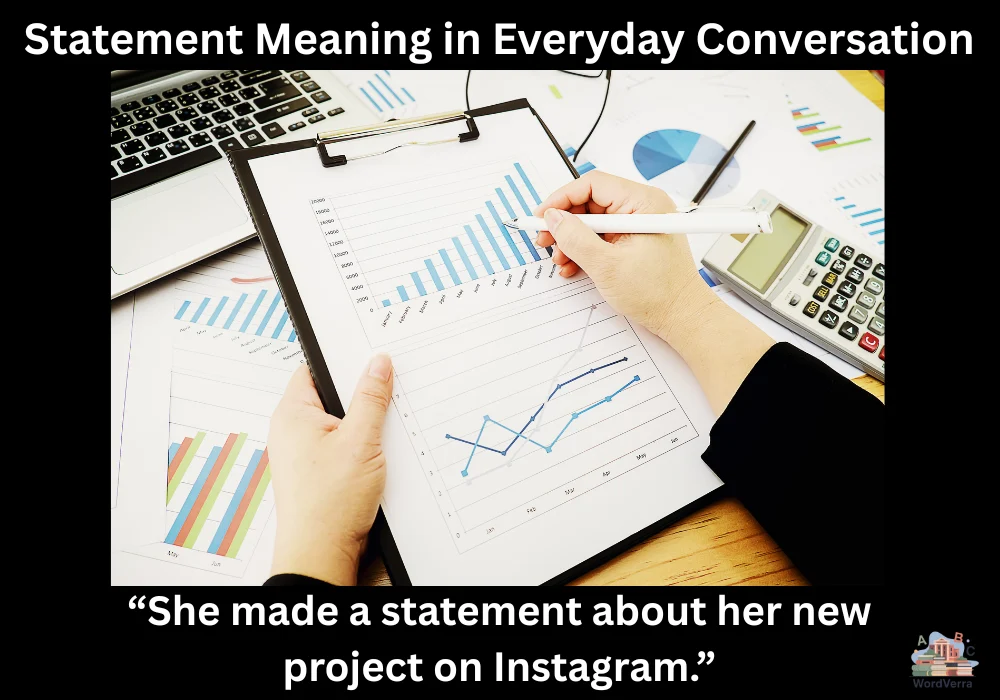
In daily life, statement usually refers to a remark or declaration.
Examples:
- “She made a statement about her new project on Instagram.”
- “That comment is a clear statement of his opinion.”
It can also be used metaphorically to indicate style, confidence, or self-expression:
- “Wearing bright colors can be a fashion statement.”
Common Misunderstandings About Statement
Mistake 1: Confusing Statement With Sentence
- A sentence is a grammatical unit.
- A statement is an expression of meaning or fact.
Mistake 2: Assuming Statement Only Refers to Finance
- Statements can be financial, legal, or general declarations.
Mistake 3: Using Statement for Informal Chat
- Informal chat may use remarks or comments, but statement implies some formality or purpose.
How to Use Statement Correctly in Sentences
Spoken or Written Declaration
- “The president issued a statement regarding the new law.”
Financial
- “I need a bank statement for my visa application.”
Legal
- “The suspect gave a statement to the authorities.”
Figurative
- “Her red dress was a fashion statement at the party.”
Incorrect Example:
- “I want a statement of ice cream.” ❌
(This does not convey a declaration or expression.)
Statement Meaning in Modern Context (2026)
In 2026, statement remains relevant across multiple domains:
- News and Media: Press statements inform the public
- Finance: Digital banking statements are widely used
- Social Media: People post statements to express opinions or share updates
- Fashion & Lifestyle: Statement items convey personality and style
The versatility of the word allows it to be both formal and expressive.
Statement Meaning in Simple Words (Quick Reminder)
A statement is something you say or write to express an opinion, fact, or declaration.
Conclusion
To summarize:
- A statement can be a remark, financial record, legal declaration, or expression of opinion
- Its meaning depends on the context — casual, professional, legal, or financial
- Understanding statement meaning improves communication, comprehension, and expression

Ghumman is a dedicated author at Wordverra, focused on delivering clear, accurate, and high-quality English grammar content for students and learners. With a strong commitment to language clarity and practical learning, Ghumman creates well-researched explanations and examples that make complex grammar rules easy to understand. The goal is to help readers build a solid foundation in English and use the language confidently in academic and everyday settings.